




Cheteshwar Pujara Exclusive: 'The Gabba Wall' On His Grit, Legacy And Life After Retirement
In an exclusive interview with NDTV, Cheteshwar Pujara shed light on his decision to retire from all formats of the game and also gave a glimpse of what the second innings would look like.
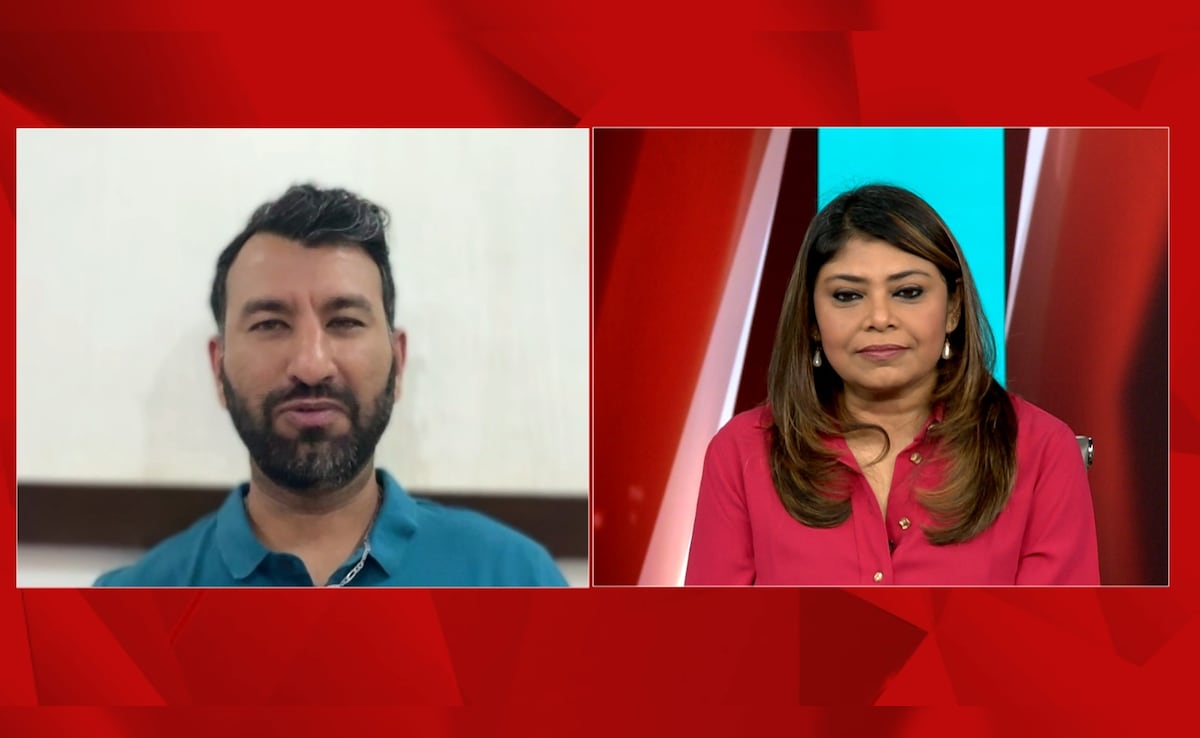
- Cheteshwar Pujara retired from all cricket formats with over 7,000 runs in 103 Tests
- Pujara is known for his defensive, patient batting style in Test cricket
- He credited his success to sticking to his strengths and team-first approach
Cheteshwar Pujara, dubbed as "Chetesh Warrior" by many, retired from all cricket formats with over 7,000 runs in 103 Tests, ranking eighth among India's top Test run-scorers. His true legacy lies in his resilience, spending countless hours at the crease, facing deliveries with unwavering patience. Often compared to Rahul Dravid, the "Great Wall," Pujara is considered one of the last of a rare breed of defensive Test stalwarts. In an exclusive interview with NDTV, Pujara took us through an enthralling journey that did have its ups and downs but the process also helped Indian cricket discover and nourish a rare gem that will be remembered for his steadfast presence at the crease, embodying the art of Test cricket with unmatched grit and determination.
Question: I have to ask you about the numerous tributes that you've been getting over the last 48 hours. Tell us which one has stood out for you?
Pujara: I think it has been very overwhelming because in the last 48 hours, all my teammates, the people I've worked with, the coaches, my family members, my friends, and a lot of acquaintances have reached out. It's an honor because when you have represented the country for such a long time, you hear from people about your journey, and you also start reflecting on how you started. Firstly, I would like to say that it's an honor for me to represent the country for such a long time and to be able to participate in some of the great series as well. So, I'm fortunate enough to have played cricket for such a long time. But at the same time, it is a very satisfying moment for me as I am retiring from cricket. When you hear from people, when you hear from your family members and friends, and when they start talking about your journey, it's a great feeling.
Question: Many see you as the last of a dying breed in Test cricket, especially in an era of aggressive T20-style batting. What are your thoughts on this, and do you believe that your style of play also has a crucial role in modern-day Test cricket?
Pujara: Yes, it does. But at the same time, if you look at the current Indian Test side or any Test side in the world, players are getting picked based on their performances in the T20 or ODI format. So, they are sticking to their strength. Their strength is to play attacking cricket and to play shots, which they are doing. But at the same time, they are learning to defend and leave the ball. They're trying to bat according to the situation of the game, which is very important.
The game is changing, and that's why I would say that one has to stick to their strength. But there is always a role for a player who plays conventional Test cricket. When it comes to Test cricket, you always try to bat according to the situation of the game and the conditions out there. If the ball is moving a bit, if there is some help for the bowlers, you still need to respect those spells and then try to play your shots. So yes, the game is definitely changing and moving forward, with players playing a little more attacking cricket. But at the same time, if you still want to play conventional Test cricket, there is always room for that.
Question: I'll pick up a quote from your former captain Virat Kohli where, after one of your innings, he said, "We didn't want him to get into the shell. We want Pujara to bat to his potential. Once he starts scoring runs, he will go with the composure that he already has." But there was constant pressure on you to score at a certain rate. How difficult was it for you to convince people in your own inner circle that you have a certain brand of cricket? Share a little about your relationship with the likes of Virat Kohli and Ravi Shastri, who constantly put that kind of pressure on you.
Pujara: Well, as I was mentioning earlier, one has to stick to their strength, and that's what I did in my cricketing journey. My strength was to defend the ball well, try to play according to the merit of the ball, and also understand different phases of the game. Based on that, whatever is best for the team, that's what you try to do. Over a period of time, people understood what my strength was. Early in my career, people sometimes thought, "This guy can play very aggressively, but he's not playing," but I didn't have that strength. Over a period of time, whether it was Ravi Bhai, Virat, or anyone else, they understood that my strength was slightly different, and then they respected that. That's why one can be successful at the highest level. If you don't play according to your strength, you can't be successful. And as long as you are doing the right thing for the team, you don't need to worry about anything else.
Question: Your wife Pooja writes in the memoir that there was a point when you had overheard a very key member of the Indian cricket team's coaching staff talking to someone, saying that they needed to drop you in the following Test. You went on to score a century. What does it take for a player to turn that kind of a situation into a super performance?
Pujara: As a sportsperson, you always go through ups and downs in your cricketing journey. There are times when you'll hear comments you don't like, whether they are from the support staff or your teammates. But at the same time, I've always been a player who put the team first. When you are representing the Indian team, your job is to perform to the best of your ability, and that's what I tried to do whenever I got an opportunity. My father taught me one thing very clearly: whenever you step onto the cricket field, you are not just playing for yourself; you are playing for millions and billions of cricket fans-Indian cricket fans and cricket fans all over the globe who want the Indian team to do well. So, you are representing the country, and you try to make sure that you are doing your best job when you are stepping out on the field. Whenever there was any adversity, I always used to think about the team and step onto the field asking, "What's my role? What is the best way I can contribute to the team?" And that's what I've done, and it has helped me immensely to perform well for the Indian team.
Question: Did the "Mr. Dependable" tag ever put pressure on you?
Pujara: Not really. I always looked up to Rahul Bhai; I've learned a lot from him. So, when I was put in at number three, I never compared myself with Rahul Bhai; I always wanted to play alongside him. And when I actually made my debut, I was playing alongside him. I got an opportunity to learn a lot, not just from Rahul Bhai, but even some of the great players who were part of the Indian team. If you look at the Indian team when I made my Test debut in 2010, Rahul Bhai was there, Sachin Tendulkar was there. We had VVS Laxman who was also there. Then Virender Sehwag and Gautam Gambhir used to open the innings at that time. M.S. Dhoni was the captain. Zaheer Khan, Harbhajan Singh-some of the great players India had produced were part of that squad. I might be missing a few more names, but it was a great moment for me to have made my debut with some of the great players because when you are part of that, you learn a lot as a young player, and that experience has taught me a lot in my cricketing journey.
Question: So, when you look at the current lineup of players, to whom will you transfer that tag of "Mr. Dependable"?
Pujara: Well, I don't want to put any pressure on any of the players, so I won't pick any one player. But this young Indian team is very, very talented. We have seen the results recently in England, and the way everyone is playing, I think it's a phenomenal Test lineup because our batters are doing well, our bowlers are doing well, and even the all-rounders are contributing. So, it's a great moment for the Indian team because if they carry on playing like this, not just in the Test format but even in the T20 and ODI formats, I think India will have a great few years ahead.
Question: What about Shubman as a Test batter?
Pujara: He has been exceptional. The number of runs he has scored in England, not many players can achieve that feat. Being a captain, touring England for the first time, and also leading the team for the first time, despite all those responsibilities, he was focused enough on his batting to achieve that feat of scoring more than 700 runs. It's a remarkable achievement.
Question: Now, your Test career ended without a farewell match.
Pujara: Well, I wouldn't want to dwell too much on it. At this point, I'm really happy that I've had a great opportunity to represent our great nation for such a long time, and it's a very happy moment for me because I feel proud to have played cricket in this nation where people are so passionate about the game. Whenever you are stepping on the field, people look at what the Indian team is doing. People are looking at you as a person, as a sportsperson. So, for me, it's a great joy to have represented the country, and I will stick to that rather than thinking about what hasn't happened. For me, I think this journey has been really good, and I'm really content with that journey.
Question: What is the second innings looking like?
Pujara: Well, as of now, I've just started commentating on the game; I've been a broadcaster lately. So, I would want to continue that. I have retired from all formats of this game, so I won't be playing any professional cricket going forward, not even first-class or county cricket. I've made that very clear. So, I think for now, I'll just stick to broadcasting, and then whenever any other future possibility arises, whether it's coaching or something else, I'll think about it. But as of now, I haven't thought about anything else.
 Cheteshwar Pujara