England's Aggressive Intent Neutered by Pitch That Offered no Reward
Alastair Cook used all his bowling options but track offered little hope, a complete contrast with surface prepared for Lord's Test against New Zealand.
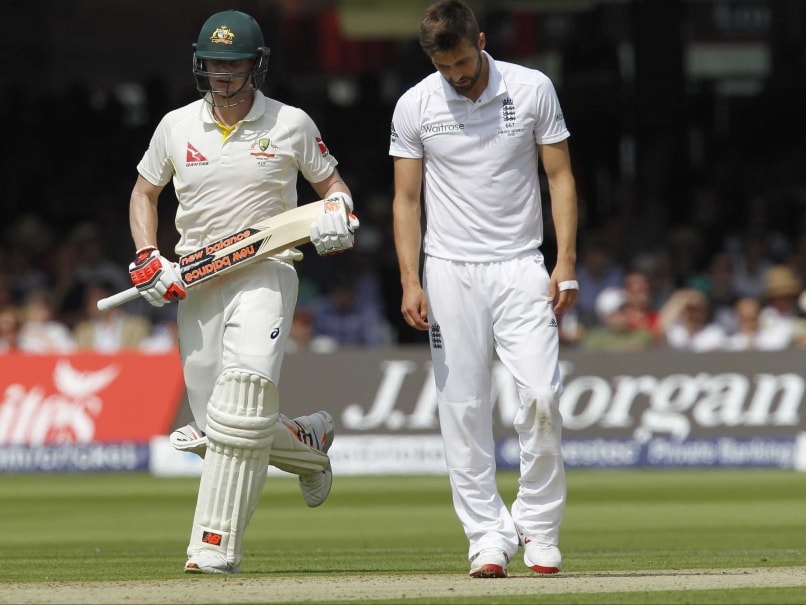
The writing was on the wall when play resumed after lunch. The England captain took a view and so did thousands of spectators, who were determined not to spoil a good lunch. (Aussies ride twin tons)
There were rows of naked white seats in the Grandstand and the Mound Stand when Stuart Broad began bowling after the interval. (Steve Smith taunts Alastair Cook)
Sometimes when the cricket is riveting and the balance of the game is see-sawing with every over even the corporate guests decide they would rather be glued to the action than seeking out another glass of bubbles with their strawberries. They could not foresee any such dramas as Chris Rogers and Steve Smith bedded in for the afternoon. (Rogers creates Lord's history)
Nor, in all honesty, could Alastair Cook. Broad began his post-prandial spell with only two slips. The rest were spread out on the off side saving runs. The pacemen would often bowl with seven men on the off side in an effort to frustrate the Australian batsmen, but with David Warner already gone this was not an easy task.
By 2.30pm two spinners, Moeen Ali and Joe Root, were operating in tandem - not because the pitch was conducive to finger spinners but because the pitch was not conducive to any sort of bowler.
Already Cook was plotting his way through what was going to be a very long day. On this sort of surface he did not want to bowl his senior citizens into the ground so he ensured that Stuart Broad and Jimmy Anderson were not overburdened.
He asked Ben Stokes and Mark Wood to attempt containing spells with those heavily packed off-side fields. Both the Durham youngsters did their best to oblige but temperamentally they are not suited to this role. Both are by nature aggressive, wicket-hunters rather than run-containers.
So they were not at their best. Stokes, in particular, after some disciplined early overs, grew frustrated and went searching for wickets. That is his instinct, one which should hardly be discouraged but this meant that he began to leak runs.
Moeen was not fully fit but any intention to look after him had to be discarded. He would bowl 22 overs. Having disposed of Warner he discovered Rogers and Smith were a little more ruthless.
There was no spin for him and, unlike at Cardiff, Smith was prepared to bide his time before allowing himself any extravagances in the form of a lofted drive. This time Smith did not waste time scurrying up and down the pitch to Moeen. He was content to play the ball on its merits, an old-fashioned strategy but rather a good one.
Cook tried Root; he even tried Adam Lyth, who propelled a maiden over of off-breaks just before tea. For some reason the temptations of Gary Ballance's wrist spin were resisted.
So bristling, aggressive, hell-for-leather England had been neutered. They left Cardiff with their feet firmly planted upon the Australians' throat. Darren Lehmann's antiquated army was in some disarray, struggling for breath. By the close of play there must have been a spring in the steps of the Australian XI - even if we had glimpsed only three of them.
There is a bit of a contradiction in England's approach. We are now well-acquainted with their determination to play a bold, attacking game. And yet here at Lord's they have ended up on a surface that neuters their younger pacemen and which makes winning a cricket match very difficult. This is hardly the ideal surface for a side determined to play with derring-do.
Contrast this track with the one that Lord's produced for the New Zealand Test in June. Then there was a distinct green tinge to the surface, which encourages more movement and pace for the quicker bowlers. On that occasion it also encouraged Brendon McCullum to bowl first.
Within the hour England were 30 for four, yet by the end of a thrilling, rapidly fluctuating first day - when those being sponsored, if they had any sense, would have forsaken their pudding to be back in their seats in time for the resumption - they were 354 for seven. There followed four days of glorious cricketing theatre culminating in an English win.
Any green tinge was barely perceptible on Thursday. We can only surmise why this was so different to the pitch for the Kiwis.
The ball behaved decorously; Rogers and Smith, recognising conditions in their favour, batted superbly, effortlessly exorcising the horrors of Cardiff to the extent that after just one day it is practically impossible for England to win this game.
What must Lehmann make of all this? The Australian coach likes pace in the pitches for his fast bowlers. This is not the surface he would have ordered for this Test.
But he was smiling on Thursday night. There is a bit more pace in this surface than at Cardiff where Lehmann concluded the bouncer was a waste of time.
A few more will be bowled here by the Australians probably with the comfort of knowing they have the cushion of 600 runs on the board. Moreover any notion of England, after their stunning victory at Cardiff, going gung-ho for the jugular against the creaking Aussies can justifiably be met by the raised eyebrows of an increasingly relaxed Australian coach.