Australia's Final Session Fireworks With Ball Bring The Cricket Back to Centre Stage
When the tourists declared and England wickets began to fall, the match sprang into life - with the debutant wicketkeeper Peter Nevill snaffling a surprising record.
The first two sessions of Friday's play offered the opportunity for the time-honoured and highly enjoyable Lord's pastime of keeping an eye on the cricket while bumping into old acquaintances. There were questions to be answered. What score would Australia finish with? Would Steve Smith become the first Australian since Bill Brown in 1938 to post a Test double century here? How many overs would Moeen Ali, with his dodgy side, be compelled to bowl? Would the Pimm's run out? (566. Yes. 36. No - just in case you're interested.) (Lord's Test Day 2 Report)
But the last session permitted none of those fripperies. The cricket commanded centre stage . Once Adam Lyth had wafted in a manner that would have had Arthur Mitchell - the legendary old coach at Yorkshire after the war, dour batsman before it and probably not the inspiration for parents about to christen their sons in Australia in the 80s - shaking his head gravely. (Bomb scare near Aussie star's home)
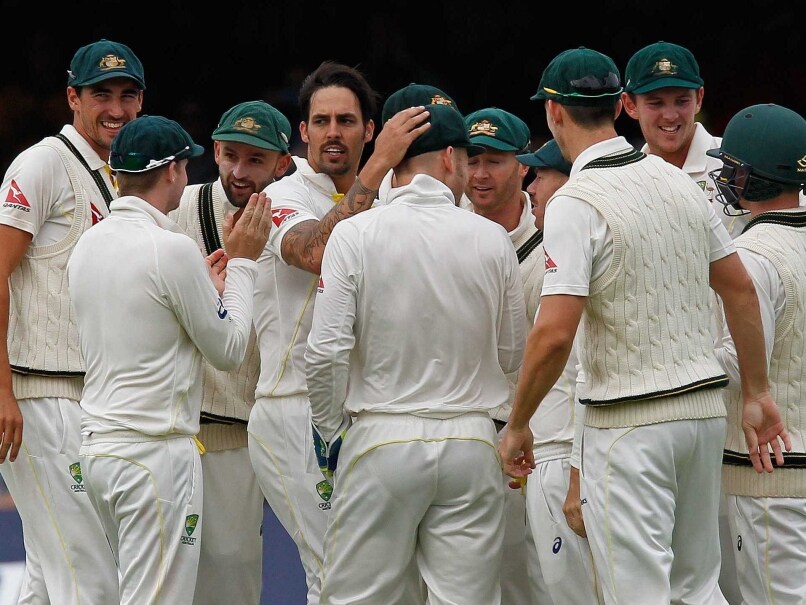
Suddenly the Dukes ball appeared wine-dark rather than cosy red and it was jagging around upon landing on this hitherto moribund surface. There was no chance of Peter Nevill, the Test debutant , feeling lonesome behind the stumps. Indeed he could start celebrating like a schoolkid when he accepted the edge from Lyth's bat off Mitchell Starc's second delivery. (Mitchell Johnson keen to re-open old England 'scars')
Nevill may not have recognised his record. He had snaffled his first victim in Test faster than any keeper, surpassing Roger Woolley of Australia and Robbie Hart of New Zealand, who both had to wait until their third ball behind the stumps for a catch. Nevill had much to smile about even though he had already betrayed his naivety. When batting he hit a handy 45, not bad for the first time out of the stables, but his demise, caught at mid-off by Moeen off Joe Root, revealed what a greenhorn he is (albeit at 29 years of age). He did not stay at the crease when the catch was taken just centimetres off the ground to seek solace from a third umpire. He just walked off.
This was compounded by a schoolboy error behind the stumps when Josh Hazlewood appealed for a catch behind when bowling to Alastair Cook. Nevill realised the ball had in fact brushed Cook's pad, therefore he kept his mouth firmly shut and routinely tossed the ball to second slip. Dear, oh dear, what is Test cricket coming to? Thereafter Nevill squatted down along with an elongated slip cordon and enjoyed the ride - rather more than the English batsmen.
The only time the home fans could roar was when was a nudge from Gary Ballance was converted from a three to a four by the umpire. Inebriated cheers - or were they merely ironic? - echoed around Lord's. But the sober could sense a spot of bother upon the horizon. The Australians were bowling fast and full and the ball was swinging. Suddenly the sluggishness of the pitch was an irrelevance. If Cardiff triggered dizzy, hazy memories of 2005, this was 2013-14 revisited with successive English batsmen being haunted by the extra venom and pace of their opponents with Mitchell Johnson to the fore.
The ball somehow sizzled underneath the bat of Ballance and around the bat of Ian Bell, who did not seem to consider the possibility that Hazlewood might conjure a little away swing.
Meanwhile Root, perhaps because he has been in such princely form recently, stood on his toes for an ambitious back-foot drive to present Nevill, who must be enjoying this Test cricket business, with another victim. Old Ticker Mitchell would not have been impressed by that either.
Thus the tables had been not so much turned as hurled up in the air before landing with an almighty crash. Moreover if those in charge of English cricket had politely asked Lord's to produce this kind of pitch, brown and devoid of much pace - and this is a substantial if - the folly of their thinking had been exposed.
This surface is truer than the one at Cardiff and a little quicker. On the evidence so far it is very hard for the English bowlers - not so tall, not so fast - to impose themselves. However the Australians in that compelling, chastening final session demonstrated that their two Mitchells could cause considerable damage alongside Hazlewood. The English bowlers had been neutered but not those of the Australians; hence the melodrama of the final two hours.
As for all those fascinating conversations of the dreamy first two sessions when the cricket was little more than a pleasing backdrop, they will have to wait for another day