








If Not a Breakthrough, a Break From the Past
Often off-target and limited in his movement, the third-seeded Nadal, one of the game’s supreme fighters. Defeating him though has not brought out emotions from rivals that used to be witnessed earlier.
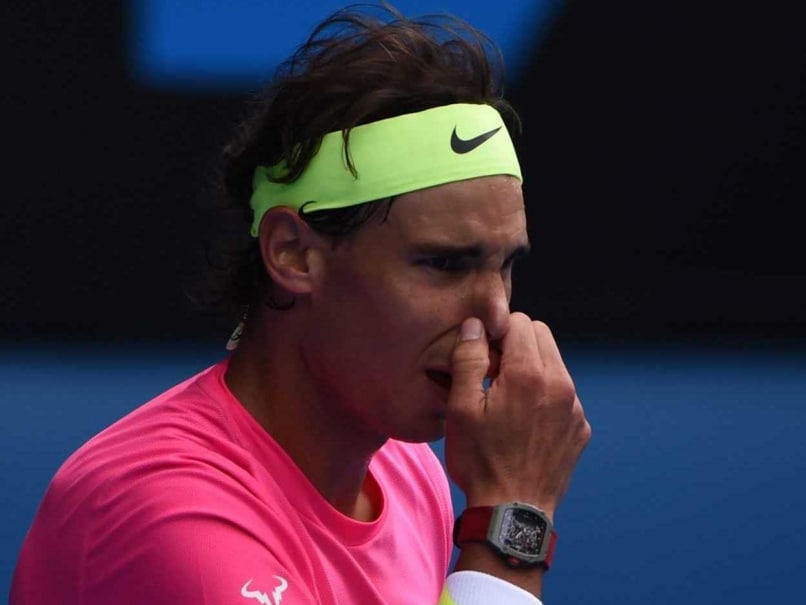
Rafael Nadal has always seemed to enjoy the chase more than the trophy, which may be why he is always biting his trophies.
But this year's chase at the Australian Open looked much less enjoyable than usual as his form and his physical condition swung wildly from match to match, sometimes even from set to set.
It nearly ended in the second round against Tim Smyczek, a U.S. qualifier, and it ended in reality against Tomas Berdych in the quarterfinals Tuesday.
Often off-target and limited in his movement, the third-seeded Nadal, one of the game's supreme fighters, managed to create suspense only in the final set of Berdych's 6-2, 6-0, 7-6 (5) victory.
The surprise was not just that Nadal lost relatively meekly; it was that Berdych did not hurl himself to the blue court and break down in tears of joy and release. This was an exceptional, potentially career-shifting moment for him, and if there is a place where departed tennis stars gather in the next life, Vitas Gerulaitis was surely feeling empathetic.
"And let that be a lesson to you all: Nobody beats Vitas Gerulaitis 17 times in a row," Gerulaitis said in 1980 after he had kept Jimmy Connors from beating him yet again.
Nadal had made it to 17 against Berdych, but as it turned out, nobody - not even the usually relentless Majorcan - could beat Berdych 18 times in a row.
"Well, no," Berdych said, grinning over the outcome after grimacing so often in the past about Nadal.
Berdych, the No. 7 seed, is not out of the woods here.
In the semifinals, he will face Andy Murray, who has been much less of a flickering flame in Melbourne than Nadal. Murray ended the run of the 19-year-old Australian Nick Kyrgios on a cool, blustery night with a poised 6-3, 7-6 (5), 6-3 victory.
"It's like playing against a brick wall out there," the former No. 1 Lleyton Hewitt said on Australian television. "Andy Murray is moving as well as I've seen in a long time, and he'll go close to winning this championship."
Murray, 27, and Berdych, 29, are in a happy place after recently announcing their engagements. Berdych's record against Murray is 6-4, but Murray, returning to top-level play after an up-and-down 2014, looks particularly menacing even if Berdych has a potential insider edge.
After failing to persuade Murray's former coach Ivan Lendl to join his team this season, Berdych hired Dani Vallverdu, Murray's former assistant coach and longtime friend.
"My goal isn't to beat Dani; my goal is to beat Berdych," said Murray, now coached by the former women's No. 1 Amelie Mauresmo. "I also know what Dani thinks of Berdych's game because he's told me, so it works both ways."
Vallverdu is no superstar mentor in the vein of Lendl or Boris Becker, who is now helping to coach top-ranked Novak Djokovic. But Vallverdu has had a long and fruitful apprenticeship at the elite level, helping Murray in 2013 to become the first British man to win Wimbledon in 77 years.
"He changed a lot of positive things," Berdych said of Vallverdu. "And the best is I'm really able to execute them really, really quickly. That's how it should be."
Coaching changes in tennis - a repetitive sport full of road trips, where relationships risk turning stale - often generate a new sense of optimism and energy. Above all, Berdych looked serene under pressure Tuesday.
He has had much success in his career, reaching the 2010 Wimbledon final, featuring regularly in the business end of Grand Slam tournaments and winning the Davis Cup twice with the Czech Republic. But he is also one of the unfortunate players who have had to settle for the scraps in a tennis age dominated by the so-called Big 4: Nadal, Djokovic, Murray and Roger Federer.
Berdych is still likely to remain in the second tier in the tennis annals, but this has been a strong phase for that group, with Stan Wawrinka winning the Australian Open last year and Marin Cilic taking the U.S. Open in September.
Even if Berdych falters against Murray, he has joined Jo-Wilfried Tsonga of France as the only players to beat all of the Big 4 at least once in a Grand Slam tournament.
The critical phase came late in the third set when Nadal resumed playing more like himself, ripping forehands and projecting intense desire. With Nadal's performance improving, Berdych played a bold service game at 4-4 to keep the momentum from shifting, saving one break point with a gutsy second serve that Nadal could not handle and staving off a second with an ace.
Berdych remained calm after failing to convert on two match points with Nadal serving at 5-6 and held it together again after Nadal rallied from a 1-5 deficit in the tiebreaker to 4-5.
Anyone familiar with the history of this un-rivalry had to be wondering if Berdych might crack, if the scar tissue would prove too thick to hit through. But he managed it, and the only caveat Tuesday was that Nadal was so far off his peak that some of the satisfaction in beating him had to be missing.
When a reporter suggested that he had played a "so-so match," Nadal good-naturedly corrected him.
"No, not so-so, very bad," he said. "You can say it. No problem."
© 2015 New York Times News Service