









For Canadian teenager, to belong is to believe
Eugenie Bouchard defeated 14th seed Ana Ivanovic - the Serbian who had earlier ousted Serena Williams, with her proactive and fearless tennis.
Eugenie Bouchard is in the Australian Open semifinals because she never thought she was not supposed to be.
With a sense of purpose and belonging on the big stage that eludes many more experienced players, Bouchard came back to defeat Ana Ivanovic 5-7, 7-5, 6-2 in her quarterfinal match Tuesday, playing proactive, fearless tennis even in the tightest moments of the match.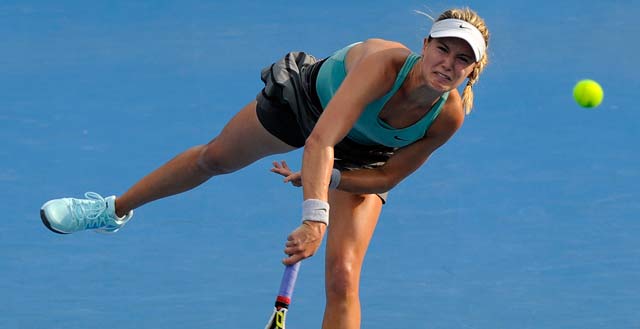 Bouchard, a 19-year-old who goes by Genie, came to Melbourne last year ranked No. 145 and lost in the second round of the preliminary qualifying draw.
This year, Bouchard came to Melbourne ranked 31st after a season of rapid but steady improvement that earned her the WTA Newcomer of the Year award. Seeded 30th, she avoided facing another seeded player as she capably navigated her way through the first four rounds.
In the quarterfinals, she overcame the 14th-seeded Ivanovic, a resurgent former No. 1 who shocked the top seed Serena Williams in the fourth round.
"You gotta start from the bottom and now we're here, right?" Bouchard joked in an interview on the eve of her quarterfinal, co-opting lyrics from Canadian rapper Drake.
While many are surprised by just how quickly her success has come, Bouchard, who said she tries to act like she has "been there before" on the biggest stages of the sport, is not one of them.
"I do try to walk around like I belong there, and play like I belong, and every time I walk on the court I believe I can win," she said. "I think that's really important, to have that self-confidence.
"Off the court, I think I'm not cocky, I'm pretty humble, and I don't want to act like I've been there when I haven't. But when little things come, like winning some matches at Slams, I just try to take it in stride. Because I expect a lot from myself. So when it does happen, it's like OK, I knew I could do this, and now let's go to the next thing." 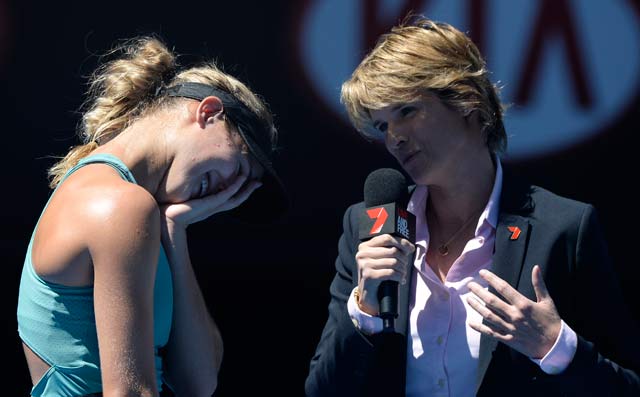 Though many of the teenagers competing in junior events believe they have outgrown the junior circuit before their eligibility is up, Bouchard stayed and took advantage of the opportunity for high-pressure competition. After playing her first junior Grand Slam at age 14, she eventually won the girls' title at Wimbledon in 2012 when she was 18, an age at which most players compete only in professional events.
But having allowed her talent to fully ripen before moving beyond the junior ranks, Bouchard has made a near-seamless transition to the professional ranks, a model of patience that could serve as a template for other young players.
Bouchard has employed a coach in Nick Saviano who serves as a link between her junior and senior success. Saviano has helped develop the games of other emerging young talents, like the American Sloane Stephens and the Briton Laura Robson, but it was Bouchard with whom Saviano decided to travel on the tour, having previously turned down several offers from players over the years.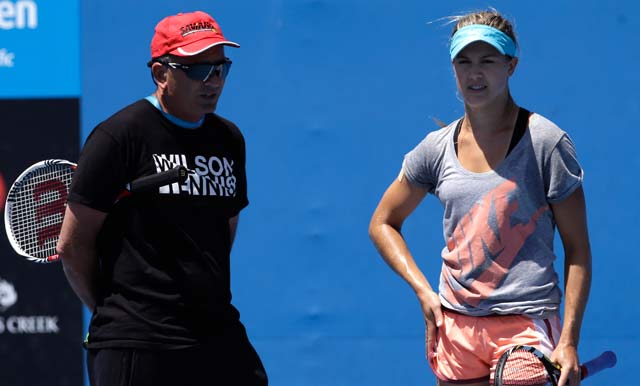 For Saviano, Bouchard's willingness and ability to learn was a deciding factor.
"She can process information very quickly, and she applies it," Saviano said of Bouchard, who first worked with her when she was 12. "She's a very good athlete, she has good focus, and she has other factors. She feels comfortable on a big stage, which helps."
Saviano believes that Bouchard is capable of raising her game to a level where simply playing her own game can be enough to beat anyone.
"She'll make tactical adjustments, and so on, but it's more about her developing her skills and being able to impose her skills on other people as opposed to constantly reacting to everyone else," he said. "When you watch Nadal or Federer or Serena Williams or Sharapova, they make little adjustments, but basically you're seeing them impose their game on other people, and that's the mentality I want you to see from her."
© 2014 New York Times News Service