


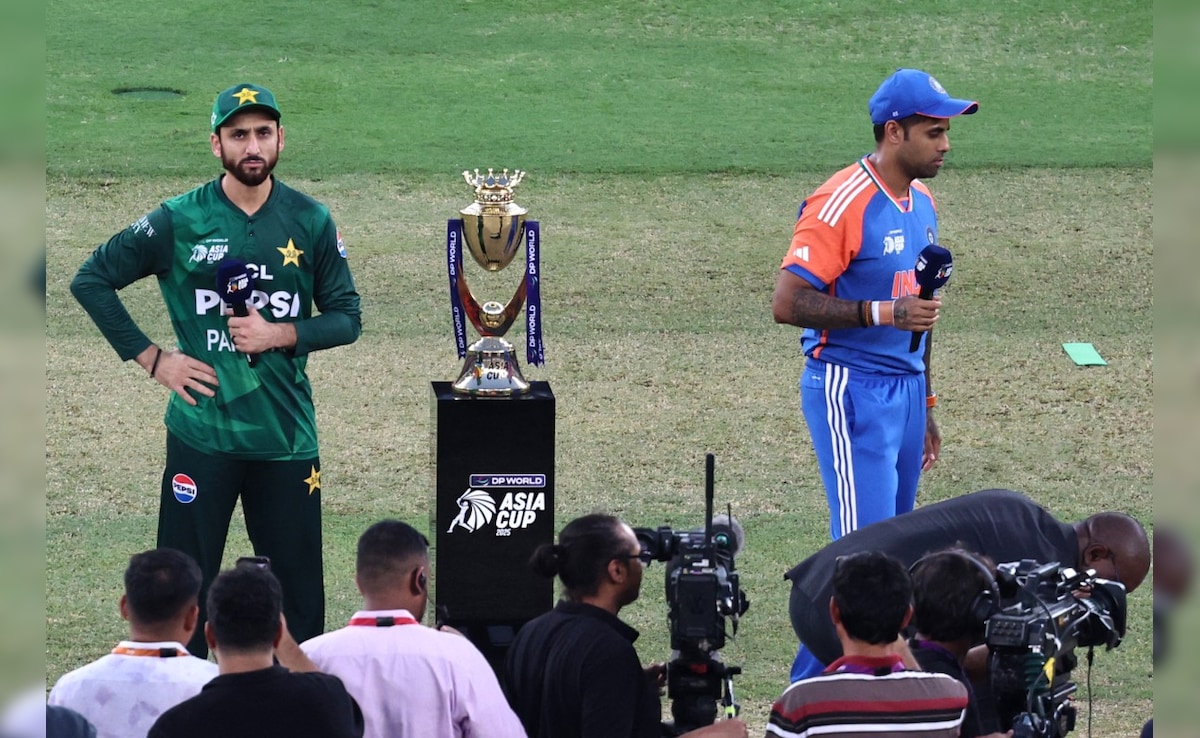
Asia Cup Handshake Row 2.0 Loading? India To Face Pakistan In T20 World Cup, Says Report
In a move that brings back one of cricket's most high-octane rivalries, the Indian national cricket team and the Pakistan national cricket team have been placed in the same group for the upcoming 2026 ICC Men's T20 World Cup.
- India and Pakistan are reportedly in the same group for the 2026 ICC Men's T20 World Cup
- India have been grouped with Pakistan, Netherlands, Namibia, and the United States
- The other group included Sri Lanka, Australia, Zimbabwe, Ireland, and Oman in a five-team pool
In a move that brings back one of cricket's most high-octane rivalries, India national cricket team and Pakistan national cricket team have been placed in the same group for the upcoming 2026 ICC Men's T20 World Cup, co-hosted by India and Sri Lanka. The decision comes despite the heated off-field drama and tension surrounding their recent encounters during the 2025 Asia Cup which included controversial gestures and political overtones. According to reports, the draw aims to maintain competitive equity rather than letting previous "shenanigans" dictate grouping decisions.
The group draw assigns India currently ranked No. 1 in T20Is alongside Pakistan, the Netherlands, Namibia and the United States. With India and Pakistan being the only Test-playing nations in that pool, the setup is widely seen as tailored to their likely progression to the Super Eight stage. Interestingly, India's matches in the group will take place across key venues in India: Mumbai, Kolkata, Chennai, Delhi and Ahmedabad, while Sri Lanka's leg will mainly be hosted in Colombo and Kandy. If Pakistan reach the final, the decider may shift to Colombo instead of Ahmedabad.
For Sri Lanka, the co-host alongside India, the draw presents an immediate challenge: they have been grouped with full-member heavyweights Australia, Zimbabwe, Ireland and Oman - a five-team pool with only one Associate nation, meaning Sri Lanka will face high-stakes cricket right from the start.
For India and Pakistan, the repeated meeting in major tournaments underscores the enduring appeal of their rivalry. But this time, the context is not just about another face-off, it's about strategic alignment and tournament design. The question now is how both sides perform when their paths are destined to cross under the bright lights of a global event co-hosted by India and Sri Lanka. As group play unfolds, fans of both teams will naturally circle the fixture, but the larger story lies in how the draw positions them for the long haul.
Ultimately, this group placement signals that for the tournament architects, structure matters more than spectacle and that India-Pakistan matches, as electric as they are, are part of a broader competitive design, not just a headline.
In the end, this group shows that the organisers care more about a fair tournament format than just creating big moments. India-Pakistan matches may be exciting, but they are simply a part of the overall competition, not the only focus.
 India Cricket Team
 Pakistan Cricket Team