





Suryakumar Yadav, Gautam Gambhir Differed On 1 Name In Indian T20 Team. India Captain Reveals 'Equation'
Suryakumar Yadav, Indian cricket team's T20 World Cup-winning captain, has highlighted his strong working relationship with coach Gautam Gambhir
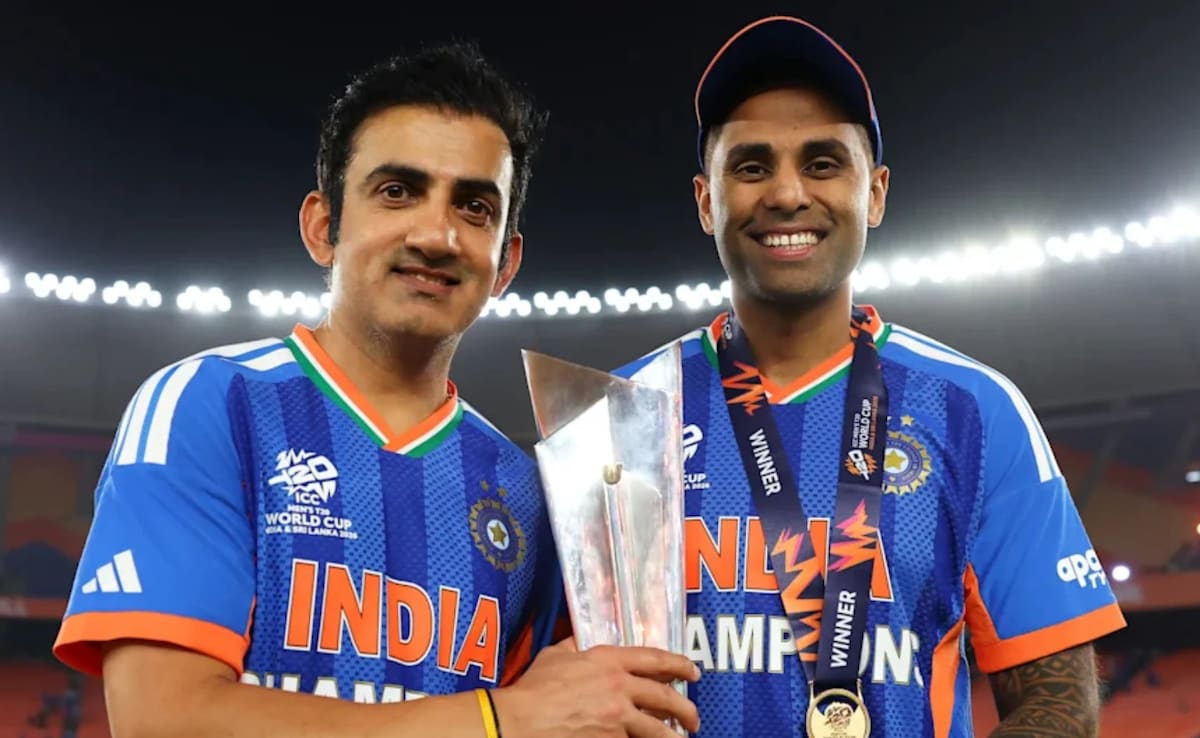
- Suryakumar Yadav and coach Gautam Gambhir agreed on 14 of 15 Indian T20I team selections initially
- Yadav described their relationship as a younger brother and elder brother dynamic
- He said T20 batting is 70-75% reaction and 25% instinct during play
Suryakumar Yadav, Indian cricket team's T20 World Cup-winning captain, has highlighted his strong working relationship with coach Gautam Gambhir. In a podcast with news agency PTI, Yadav revealed that the duo was almost perfectly aligned when they first sat down to select the team after he was handed the reins and Gambhir took over as coach. "Out of 15 names we both suggested, 14 were common. That means the thinking was the same. When the goals are clear, there are no arguments, only discussions," he said.
Despite their professional success, Suryakumar said their personal dynamic remains unchanged. "I still call him 'Gauti bhai'. It is like a younger brother and elder brother relationship," he said.
Known for his 360-degree strokeplay, Suryakumar described batting in T20 cricket as largely a reactive sport, with preparation accounting for only part of the process.
"I feel batting is about 70-75 per cent reaction. The remaining 25 per cent is instinct - what you decide to do in the moment. Once you enter the ground, you are almost in autopilot mode. You try to bat with rhythm and according to the situation," he said.
He also traced the origins of his unconventional range of shots to childhood rubber-ball games in Mumbai, where uneven boundary sizes forced him to improvise.
While his audacious strokeplay is often described as high risk, Suryakumar said he tries to stay on the right side of the fine line separating courage from recklessness.
"There is a very thin line between being courageous and being reckless. I try to stay on the courageous side. But if the situation demands a high-risk shot, you have to take it. High rewards often require high-risk decisions," he explained.
With PTI inputs
 Gautam Gambhir
 India Cricket Team