



How India Women's 2025 World Cup Quest Mirrors MS Dhoni-Led Team's 2011 Magic
Harmanpreet Kaur's Team India is on the cusp of a historic Women's ODI World Cup 2025 triumph at home. Their journey has been quite similar to the one MS Dhoni's India showcased in the Men's ODI World Cup 2011.
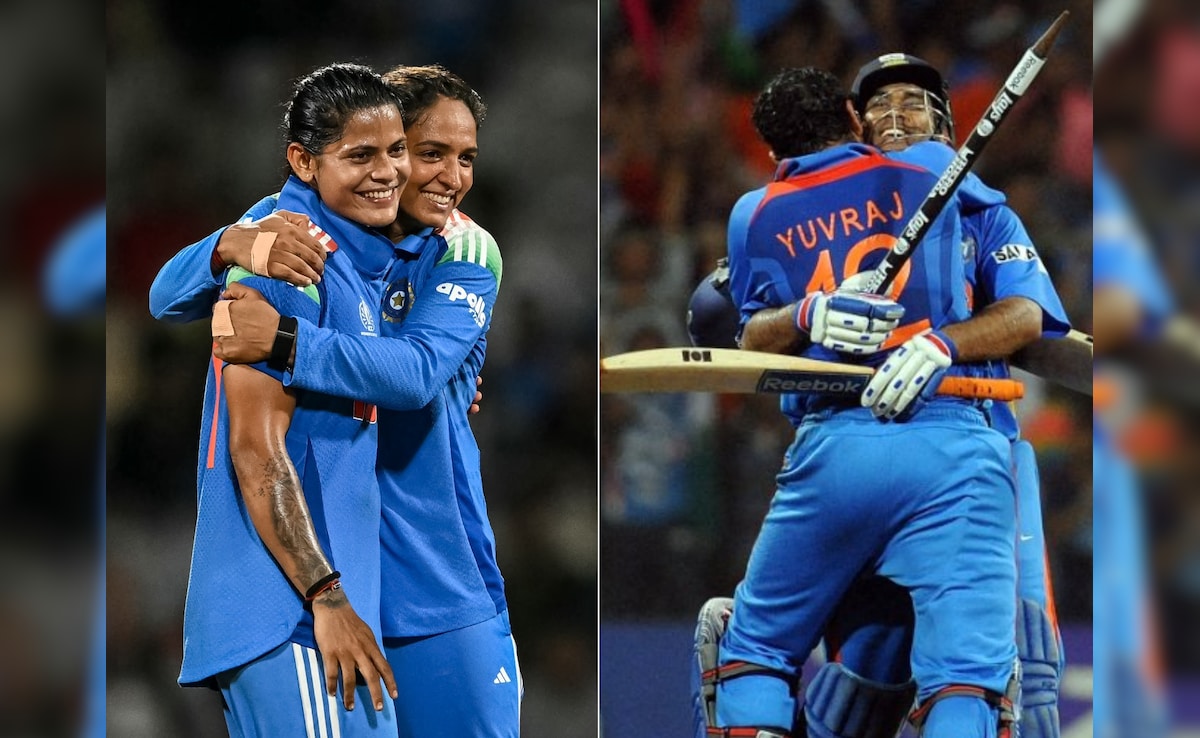
- India hosted the 2011 Men's and 2025 Women's ODI World Cup finals in Mumbai and Navi Mumbai
- Both Indian teams struggled in group stages but excelled in knockout rounds under high pressure
- In 2011, the men finished second in their group and in 2025, the women qualified fourth after a losing streak
Unarguably, one of the most celebrated moments in India's sporting history came in 2011 when the ODI World Cup culminated in MS Dhoni's iconic six in Mumbai. Fast forward to 2025, and the India Women's team, led by Harmanpreet Kaur, has scripted a remarkably similar saga in their pursuit of the ODI World Cup, whose final against South Africa is set for Navi Mumbai today. Co-hosted by India and Sri Lanka, with the showpiece at home, both tournaments have unfolded with striking parallels in knockout-stage heroics and the transformative power of home advantage. These echoes not only highlight the resilience of Indian cricket but also underscore how extreme pressure can birth new legends.
Home Soil: Privilege and Pressure
Both campaigns carry the unique blend of advantage and burden that comes with playing at home. The 2011 Men's World Cup was co-hosted by India, Sri Lanka, and Bangladesh, with the final at Mumbai's Wankhede Stadium. The 2025 Women's edition is jointly organised by India and Sri Lanka, again reserving the final for Indian shores.
This home setting has amplified expectations. Indian fans, as passionate as ever, demand the maiden Women's World Cup trophy. In 2011, the men entered under pressure to end a 28-year drought since Kapil Dev's 1983 triumph. The women in 2025 face parallel scrutiny, the nation yearning for glory in the 50-over format.
Bumpy Group Stages, Timely Peaks
Neither journey has been seamless. Both teams endured shaky league phases before peaking in the knockouts, a testament to mental fortitude.
The 2011 men finished second in their group behind South Africa, stumbling with a loss to the Proteas and a high-scoring tie against England. The 2025 women scraped into the semi-finals in fourth place after a three-match losing streak to South Africa, Australia, and England, needing a must-win against New Zealand to survive.
What unites the campaigns is timing. After mid-tournament wobbles, both sides found their best form when elimination loomed, turning potential collapse into unstoppable momentum.
Knockout Brilliance: Giants Dethroned, Heroes Born
The knockout stages have revealed the most striking symmetry.
In 2011, Dhoni's men stunned defending champions Australia in a tense quarter-final, defying predictions of struggle. In 2025, Harmanpreet's women pulled off an even bolder upset, toppling serial champions Australia in the semi-final by chasing 338-the highest successful pursuit in Women's World Cup knockout history.
Individual heroics have echoed across eras. Yuvraj Singh was the 2011 heartbeat, delivering all-round mastery, notably an unbeaten 57 in the quarter-final against Australia before Dhoni's captain's knock in the final. In 2025, Jemimah Rodrigues announced herself with a career-defining, unbeaten 127 in the record chase, backed by Harmanpreet's fluent 89.
The men conquered arch-rivals Pakistan in an emotionally charged semi-final, the women rewrote record books while dethroning Australia. In both cases, victory emerged not from dominance but defiance, a proof that Indian cricket thrives when the stakes are highest.
Will Harmanpreet Pull Off a Dhoni?
The final piece of this jigsaw awaits. One win against South Africa stands between Harmanpreet Kaur's team and history. If the trophy is lifted under Navi Mumbai lights tonight, the parallels with 2011 will be complete-and a new generation of legends will have echoed the old.
 India Cricket Team
 India Women
 South Africa Women
 MS Dhoni