DRS, Super Over to make World Cup debuts
The much-debated Decision Review System (DRS) and the Super Over, used in case of tie matches in knockout stages, would make their World Cup debut in the upcoming extravaganza which unfolds in the sub-continent on February 19.
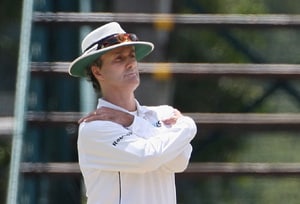 The much-debated Decision Review System (DRS) and the Super Over, used in case of tie matches in knockout stages, would make their World Cup debut in the upcoming extravaganza which unfolds in the sub-continent on February 19.
As per the playing conditions for cricket's showpiece set out by the International Cricket Council, DRS will be used in all matches.
DRS, which has been used in Test matches selectively when the two competing teams' Boards have agreed to its implementation, has been consistently opposed by the Indian board.
Sri Lanka's former World Cup-winning skipper Arjuna Ranatunga on Wednesday came out wholeheartedly in its support at a function here.
"If ICC has the technology, they might as well use it and give the benefit to the players. It is a World Cup and one decision can change the game," said Ranatunga.
DRS, which has been used in some bilateral Test series while ignored for others due to lack of agreement between the concerned boards, would be making its entry for the first time in ODI cricket.
"Each team is allowed to make two unsuccessful Player Review requests per innings. If a Player Review results in the umpire reversing his original decision, then the request has been successful and does not count towards the innings limit.
If the umpire's decision is unchanged, the Player Review is unsuccessful," the playing conditions state.
"After two unsuccessful requests by one team, no further Player Review requests will be allowed by that team during the current innings," say the playing conditions for the tournament about DRS.
"If following a Player Review, an umpire upholds a decision of 'Out', but for a different mode of dismissal from that for which the original decision was given, then the request will still be regarded as unsuccessful.
"If following a Player Review, an umpire upholds a decision of 'Not Out' on account of the delivery being a no ball for any reason, thereby not requiring any review of the ball's subsequent trajectory, then this will not be counted as an unsuccessful request and not count towards the innings limit."
The TV umpires have also been given a guide about balls pitching within the stumps for interpreting the laws on leg before wicket if called to use DRS.
"When using technology to determine where the ball pitched (as per Law 36.1(b)), the third umpire should refer to the 'point' (or centre) of the ball. Therefore if at least 50 percent of the ball pitches outside the line of leg stump, then no LBW dismissal is possible.
"When using a replay to determine the moment at which the wicket has been put down (as per Law 28.1), the third umpire should deem this to be the first frame in which one of the bails is shown (or can be deduced) to have lost all contact with the top of the stumps and subsequent frames show the bail permanently removed from the top of the stumps."
Law 36 deals with LBW decisions and the relevant subsection is about the ball pitching in line with wicket and wicket or on the off side of the striker's wicket.
In case of a tie at the Group stage, which constitutes the first round, the teams would get one point each.
In all subsequent matches (from the quarter-finals) the teams shall compete in a one over per side eliminator to determine the winner, the playing conditions state.
In the event of teams finishing on equal points in its Group, the right to play in the quarter-finals will be decided in the following order of priority:
The team with the most wins in the Group matches will be placed in the higher position.
If there are teams with equal points and equal wins in the Group matches then in such case the team with the higher net-run-rate in the Group matches will be placed in the higher position.
If following the net-run-rate calculation above there are teams which are still equal, then the team with the higher number of wickets taken per balls bowled in the Group matches in which results were achieved will be placed in the higher position.
If still equal, the team which was the winner of the head-to-head match played between them will be placed in the higher position.
In the highly unlikely event that teams cannot be separated by the above, this will be done by drawing lots.
In the quarter-finals and semi-finals, if following a tie, weather conditions prevent the one over eliminator from being completed, or if the match is a no result, then the team that finished in the higher position in the Group stage shall proceed to the semi-finals or final, as the case may be.
In the event of a tied final or no result, the teams shall compete in a one over per side eliminator to determine which team is the winner. If weather conditions prevent the one over eliminator from being completed, the teams will be declared joint winners.
White "Kookaburra" brand balls are to be used in the tournament.
The umpires have been instructed to be very strict on wide balls on either side of the wicket.
"Any offside or leg-side delivery which in the opinion of the umpire does not give the batsman a reasonable opportunity to score shall be called a wide," the playing conditions state.
Except for the Chinnaswamy Stadium at Bangalore, which has been given a concession of four yards, the playing area shall be a minimum of 150 yards from boundary to boundary square of the pitch with the shorter of the two square boundaries being a minimum 65 yards.
The straight boundaries should be a minimum of 70 yards from the centre of the pitch. No boundary should exceed 90 yards.
There is also a provision for repair or change of the pitch if it is considered too dangerous for play by the on-field umpires which has to be done in consultation with the ICC match referee and with the agreement of the two captains.
A minimum of 14.28 overs per hour have to be bowled after the umpires give allowance for time lost due to unavoidable stoppages, including application of DRS.