



Who Owns Football's Future? NDTV's Deep Dive Into FIFA's Controversial $4.2 Billion Deal
The World Cup has ended, but Infantino's tricks are by no means over. Is he altering FIFA for his own benefit? Many people view FIFA President Gianni Infantino's scheme of raising $4.2 billion from private investors as cynical.
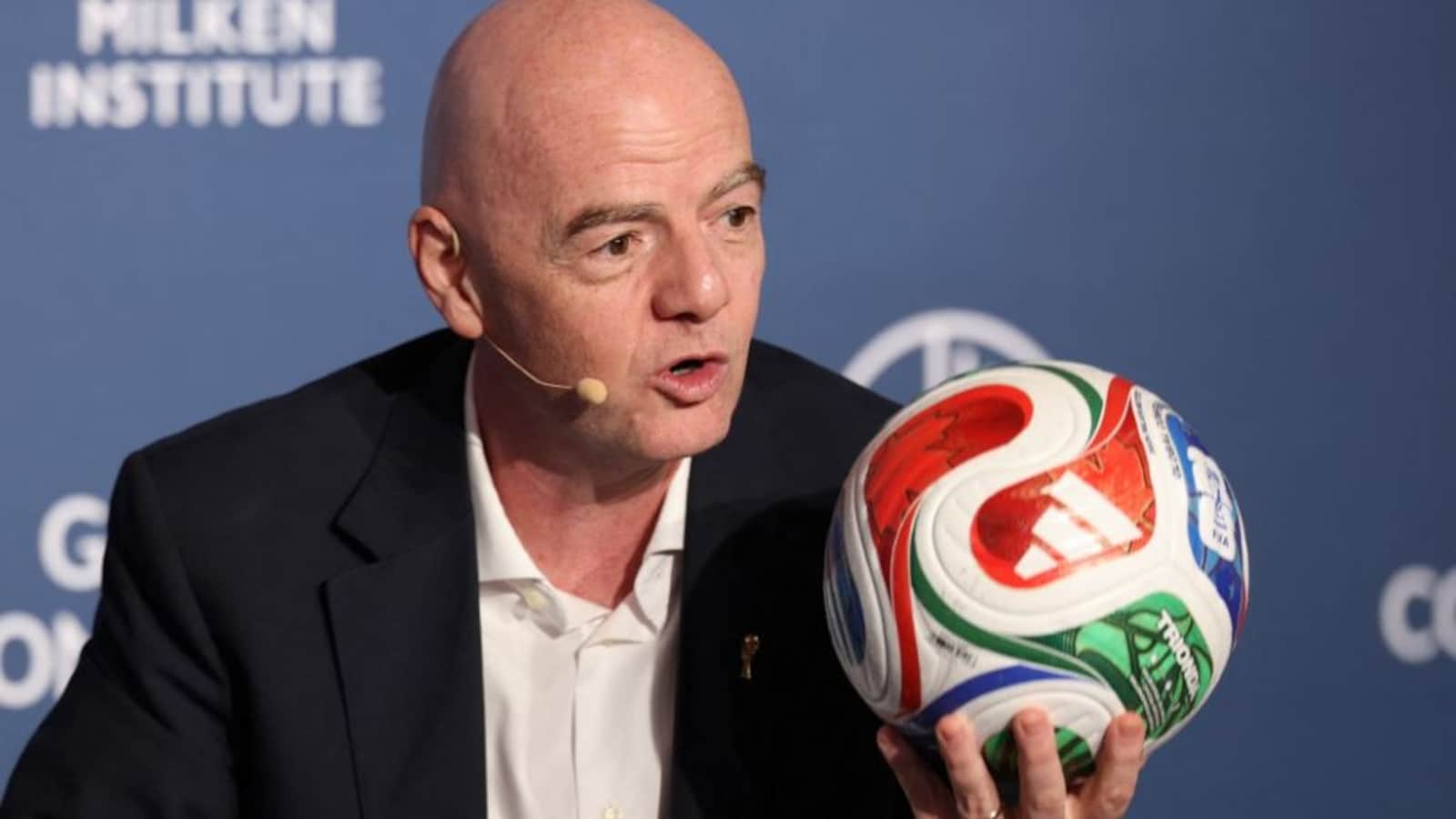
The World Cup has ended, but Infantino's tricks are by no means over. Is he altering FIFA for his own benefit? Many people view FIFA President Gianni Infantino's scheme of raising $4.2 billion from private investors as cynical, and it could end up being the largest commercial change ever in the history of the football governing body if the 211 member associations of FIFA approve it. The authorities wish to set up a new company-FIFA Forward Enterprises (FFE)-transfer to it the commercial rights for the men's and women's World Cups, the Club World Cup and its other major tournaments, and then offer up to a 21 per cent share for $4.2 billion.
At first glance it appears to be just a corporate restructuring but in fact it might end up being the most significant reallocation of influence in football since television money changed the sport's economic situation.
FIFA is not selling football; it is selling the source of football's income.
Since it is a Swiss association, FIFA has no shareholders and therefore cannot be purchased, acquired, or listed on a stock exchange; the 211 member associations remain fully in control.
The new company would control almost all of the money-making activities-such as broadcast rights, sponsorships, hospitality, licensing, ticketing, and the commercial broadcasting of FIFA's main competitions. FIFA would still be in charge of the game, while FFE would handle the revenue.
It by any means represents a revolutionary model.
Under Liberty Media, Formula One has thrived while private equity firms have for years been purchasing shares in rugby, cricket and European football.
The Football World Cup is not merely another tournament; it is in fact one of the very few sporting events capable of bringing whole countries to a standstill.
Follow the money
FIFA states that the reason for the investment is simple.
The organisation aims to launch the FIFA Fast Forward Programme, which will let each of its 211 member associations apply for up to 20 million dollars to construct academies, training centres, stadiums and community facilities.
The figures involved here are remarkably neat.
If you multiply two hundred and eleven associations by 20 million you get roughly 4.22 billion dollars, which is almost precisely the amount that FIFA hopes to obtain from investors.
The message is essentially self-evident in that private capital enters while football development leaves.
The promise is truly appealing for a great many federations, especially in Africa, in Asia and in those countries which have a smaller footballing presence. Improved facilities could alter the course of the sport for a whole generation.
It is only when the same federations are asked to approve the structure which produces the money that the questions arise, FIFA stressing that the funding will be linked to approved projects.
Yet the political implications cannot be ignored. In such a situation, when the people casting the votes also stand to gain, governance experts are likely to turn to the fine print.
The question FIFA isn't answering
Eventually, any discussion of FFE will end up on Gianni Infantino.
The Times has produced a report which has led to talks regarding the new company, with the possibility arising that Infantino could become its commissioner or chief executive after he leaves FIFA in 2031.
FIFA has not confirmed the report and has not denied it.
Infantino is in the process of designing the structure, dealing with the investors and convincing the member associations to support it; if he were one day to take charge of the company which he is currently helping to set up, it would not be at all surprising that questions regarding governance would arise.
Football versus business. In the end, someone gives in.
Even if Infantino never visits FFE after he has left office, another question will still remain.
FIFA will still be responsible for deciding the format of the tournaments, the player welfare regulations and the international calendar; its main aim, however, will be growth. There are some instances in which these objectives coincide and at other times they clash dramatically.
It is possible that the administrators will think that the calendar is becoming unsustainable, while investors seldom object to there being too many premium events to sell.
One side looks at workloads and the other looks at inventory.
Both points of view are reasonable. Yet they are not always compatible.
Since Infantino's presidency has already given us the largest World Cup, that debate will not be going away any time soon.
Then there's the investor
FIFA expects Thrive Eternal to be the one to lead the investment.
The fact that Thrive Eternal became the preferred choice is still something of a mystery.
There has never been a public bidding process, nor have the criteria for evaluation been published, and there has been no explanation given as to whether the competing investors ever had a realistic chance.
Transparency is most important when billions are involved. The fact that it is Thrive Eternal is rather unusual.
Joshua Kushner founded it just a few months ago, and its first known investment was a minority share in the San Francisco Giants of Major League Baseball. This would be the company's second previously disclosed transaction.
Joshua Kushner is also the younger brother of Jared Kushner, who was a former adviser to the White House and the son-in-law of Donald Trump.
FIFA has made it clear that the two organisations are separate; according to Reuters, Jared Kushner has no part in the proposal, and FIFA adds that there is no public evidence showing a link between the Saudi-backed investments in Jared Kushner's Affinity Partners and Thrive Eternal.
That doesn't prove anything to be improper.
This shows the reason why FIFA should address the obvious questions before people begin coming up with less helpful ones.
Is the next phase of football-or the next experiment?
It is no longer possible to ignore private funding in the world of sport.
FIFA says that this is football finally catching up.
It could be so, and if billions of dollars were to be used for building academies in countries that badly need them, the impact might be important.
The sport has likewise taken many years to restore trust following a number of governance scandals.
It now means that transparency is not merely a public relations activity but an integral part of the product.
The issue is whether FIFA can convince the rest of the football world that the body which regulates the sport is able to build a multi-billion-dollar business enterprise without confusing the boundaries between governance, business and influence.
That's a far more difficult argument to make. The decision regarding FIFA Forward Enterprises is not just a matter of raising $4.2 billion; it's about determining who is to benefit from football's future and who is to have a role in shaping it.