





Olympic Equestrian Anush Agarwalla Goes To Court Over Asian Games Non-Selection - What Exactly Happened
Indian dressage rider Anush Agarwalla has challenged his exclusion from India's dressage team for the 2026 Asian Games and approached the Delhi High Court.
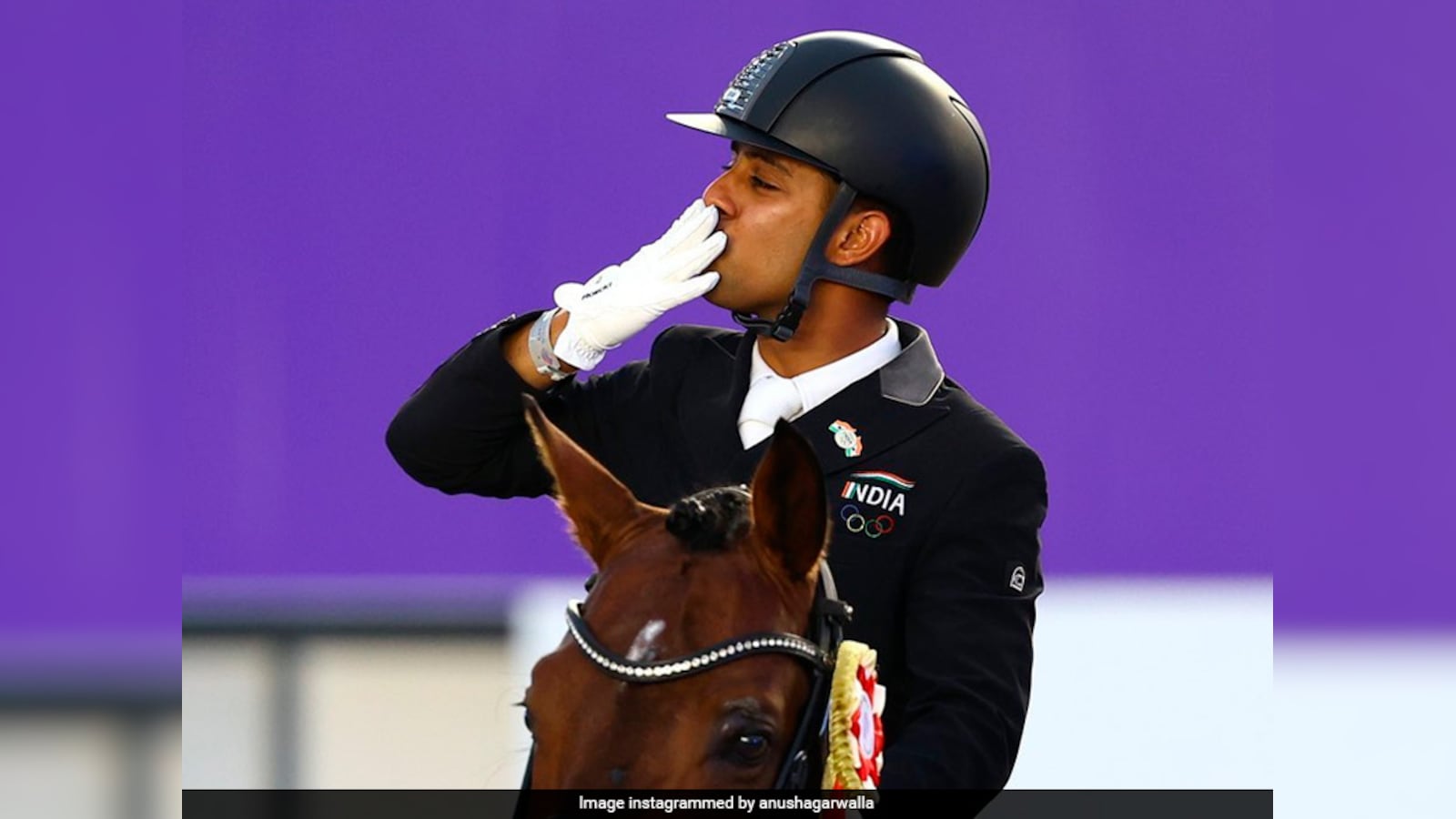
Indian dressage rider Anush Agarwalla has challenged his exclusion from India's dressage team for the 2026 Asian Games and approached the Delhi High Court. At its core, the dispute is about how the selection criteria should be interpreted and whether some of Agarwalla's international competition scores should have been counted while preparing the final order of merit. The dispute centres on the treatment of scores achieved by Agarwalla at two international competitions: CDI Hagen, Germany (April 22-26) and CDI Lier, Belgium (May 20-24).
The EFI ad-hoc panel says those scores could not be counted in the manner sought by Agarwalla because they did not comply with the selection criteria.
Agarwalla, on the other hand, has challenged that interpretation before the court.
The selection system
For Asian Games selection, riders had to compete in designated selection trials and achieve the required standards.
One of the key requirements, according to EFI, was that riders had to declare at least seven days in advance which competitions and tests they wanted to be treated as official selection trials. Competitions or tests not properly declared could be excluded from consideration.
This "seven-day declaration rule" is at the heart of the dispute.
What happened at Hagen?
On April 15, Agarwalla emailed EFI stating that only the Inter-I test at CDI Hagen would count as his third Asian Games trial. He also indicated his intention to compete in PSG and Inter-I Freestyle at Lier later.
On April 18 he made a revised request, asking that both PSG and Inter-I at Hagen be counted as part of his third qualifier.
EFI's position is that this revised request came after the seven-day deadline and therefore could not be accepted.
The Hagen score
At Hagen, Agarwalla recorded a PSG score of 70.941 per cent. However, EFI says that because the PSG test had not been declared within the stipulated time, the score could not be counted for qualification, merit ranking or selection purposes.
This 70.941 per cent score is arguably the single most important number in the dispute.
What happened at Lier?
At CDI Lier in Belgium, Agarwalla recorded: PSG: 67.294%, Inter-I: 68.824% and Inter-I Freestyle: 69.580%.
Before the competition, on May 10, Agarwalla informed EFI that: Inter-I and Inter-I Freestyle at Lier should be treated as part of his third trial. PSG at Lier should be treated as part of a future fourth trial.
In the same communication, he referred to the Hagen PSG score as completing the PSG component of the third trial.
EFI objected to this approach. According to the federation, the selection criteria did not permit riders to combine tests from different competitions or split one trial across multiple events.
Why does EFI say Agarwalla was not selected?
The federation says the Dressage Selection Committee examined all performances and prepared the final order of merit in accordance with the approved criteria.
According to EFI's court filings: the disputed Hagen PSG score was excluded.
The proposed combination of Hagen and Lier results was not accepted. The committee unanimously finalised the team based on the applicable criteria and current performances.
EFI's filings indicate that a tie-break situation arose between Hriday Chheda and Anush Agarwalla, both of whom had two Team MERs.
The final ranking resulted in: Shruti Vora, Gaurav Pundir, Jai Sud and Hriday Chheda Anush Agarwalla (Reserve No. 1)
What are MERs and why are they important?
MER stands for Minimum Eligibility Requirement, the performance benchmark that riders must achieve to be considered for selection.
Because both riders were credited with two Team MERs, EFI says a tie-break was required, after which Chheda secured the fourth and final place in the team while Agarwalla was placed as first reserve.
The dispute is also about whether the interpretation of the selection rules deprived Agarwalla of an additional qualifying performance that could have improved his position relative to Chheda in the final rankings.
What is EFI saying in court?
EFI argued that the challenge was filed after the selection process had effectively concluded.
According to the federation, the selection recommendations were finalised on June 14-15. The Ad-Hoc Committee approved them on June 15. The squad was announced on June 16. Final entries for the Asian Games were uploaded on the FEI portal on June 19.
The writ petition was served later on June 19.
EFI has argued that once final entries were submitted, changes could not ordinarily be made under the applicable regulations.
What will the court have to decide?
The case essentially boils down to two questions: Was EFI correct in excluding Agarwalla's 70.941% PSG score from Hagen because of the declaration requirement? Did the selection criteria permit the kind of score combination and trial structure that Agarwalla proposed using his Hagen and Lier performances? If the court agrees with EFI's interpretation, the announced team is likely to stand. If it finds merit in Agarwalla's challenge, it could examine whether the selection process requires reconsideration.
The disagreement is over whether the 70.941% PSG score at Hagen and the subsequent 67.294%, 68.824% and 69.580% scores at Lier could legally be used for Asian Games selection under EFI's rules.
EFI says they could not be counted in the manner sought by the rider.
(Except for the headline, this story has not been edited by NDTV staff and is published from a syndicated feed.)