Iran Once Brought Roses For America At A World Cup. Now It Arrives Under Fire
Iran is at the 2026 FIFA World Cup. So is the United States, as they are one of the hosts. The last time the two sides met at a World Cup event, the Iranians gave white roses to their American counterparts. This time, things are more tensed.
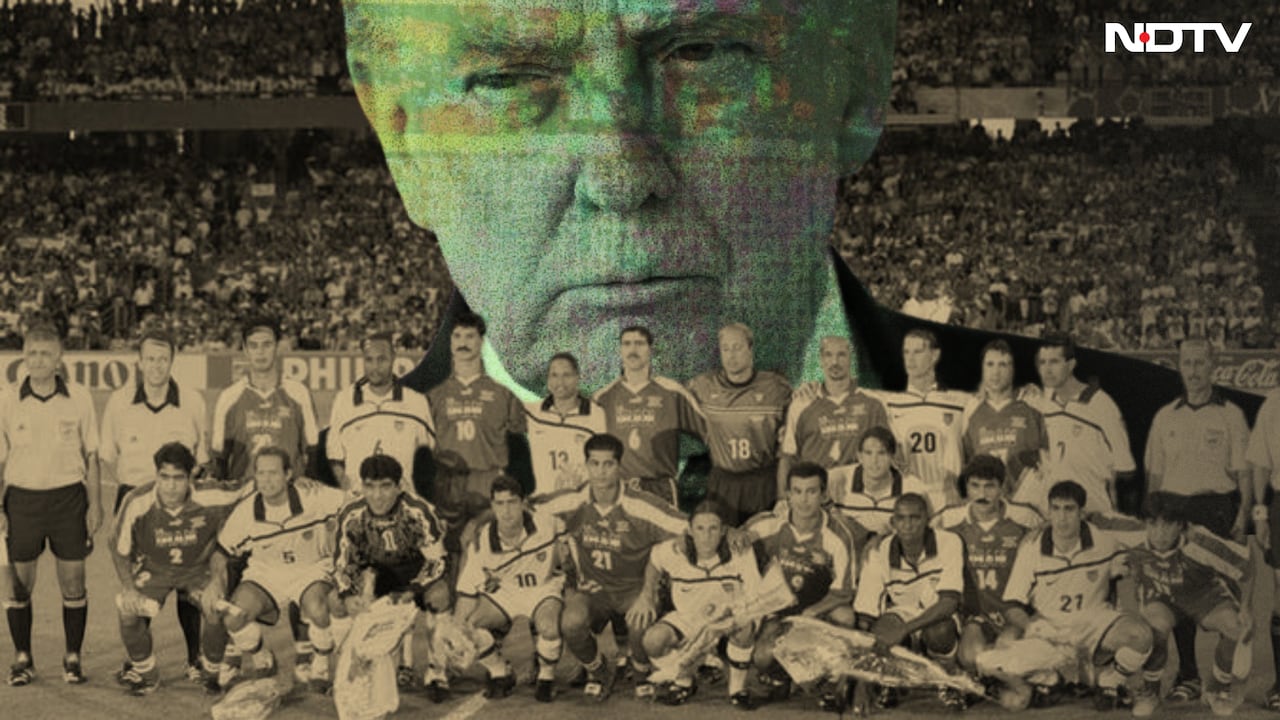
In June 1998, on a warm evening in France's Lyon, something happened that now feels unthinkable. At least, in hindsight.
The players of Iran walked onto the football pitch carrying white roses. Before a politically charged World Cup match against the United States, the footballers handed the flowers to their American counterparts. The teams posed together. They embraced and smiled. A photograph of all 22 players standing side by side became one of the enduring images in the tournament's history. Momentarily at least, politics was put out of the picture for the true spirit of football to be celebrated.
For one brief evening, 22 footballers accomplished what generations of politicians, diplomats and foreign policy experts had been trying to do -- get Iran and the US to stand together without arguing like squabbling children.
Two countries that had spent nearly two decades exchanging accusations, sanctions and ideological hostility briefly exchanged flowers instead.
It is safe to say the mood has changed. Twenty-eight years later, it is unlikely that such a gesture will be repeated.
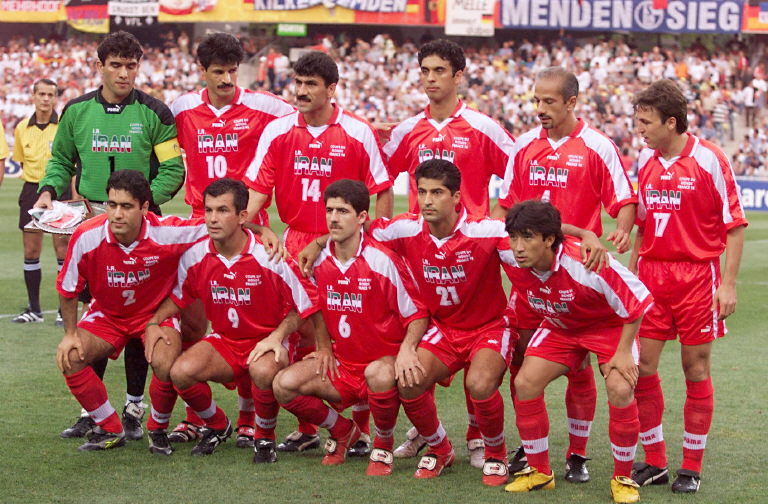
Iranian players pose for the official team picture, June 25 at the Stade de la Mosson in Montpellier, south of France, before their FIFA World Cup Group F first round match against Germany. (From top left: Ahmad Abedzadeh, Ali Daei, Nader Mohammadkhani, Mehdi Pashazadeh, Mohammad Khakpour, Javad Zarincheh; bottom left, Mehdi Mahdavikia, Hamid Estili, Karim Bagheri, Mehrdad Minavand, Khodadad Azizi)
Iran's national football team is heading to the 2026 FIFA World Cup under circumstances that would have been difficult to imagine even during the tensions of the late 1990s. The US and Israel have been engaged in a military confrontation with Iran since February. Iranian players have been granted visas only after weeks of uncertainty while several members of the delegation have been denied entry. Iranian supporters are embroiled in a dispute over access to tickets. The team has relocated its base camp from Arizona to Mexico. Even its movements into the US have become matters of diplomatic clarification.
A World Cup Overshadowed By Conflict
Iran's preparations for the tournament have been unusually complicated considering the fact that it has been subjected to an intense bombing campaign by the US and Israel since late February.
The team is currently training in Mexico's Tijuana, roughly 800 km from their original base in the US state of Arizona. The move was driven by growing uncertainty over whether Iranian players and staff would receive visas and by a feeling inside Iran that the team's physical presence in the US should be kept to a minimum amid the conflict.
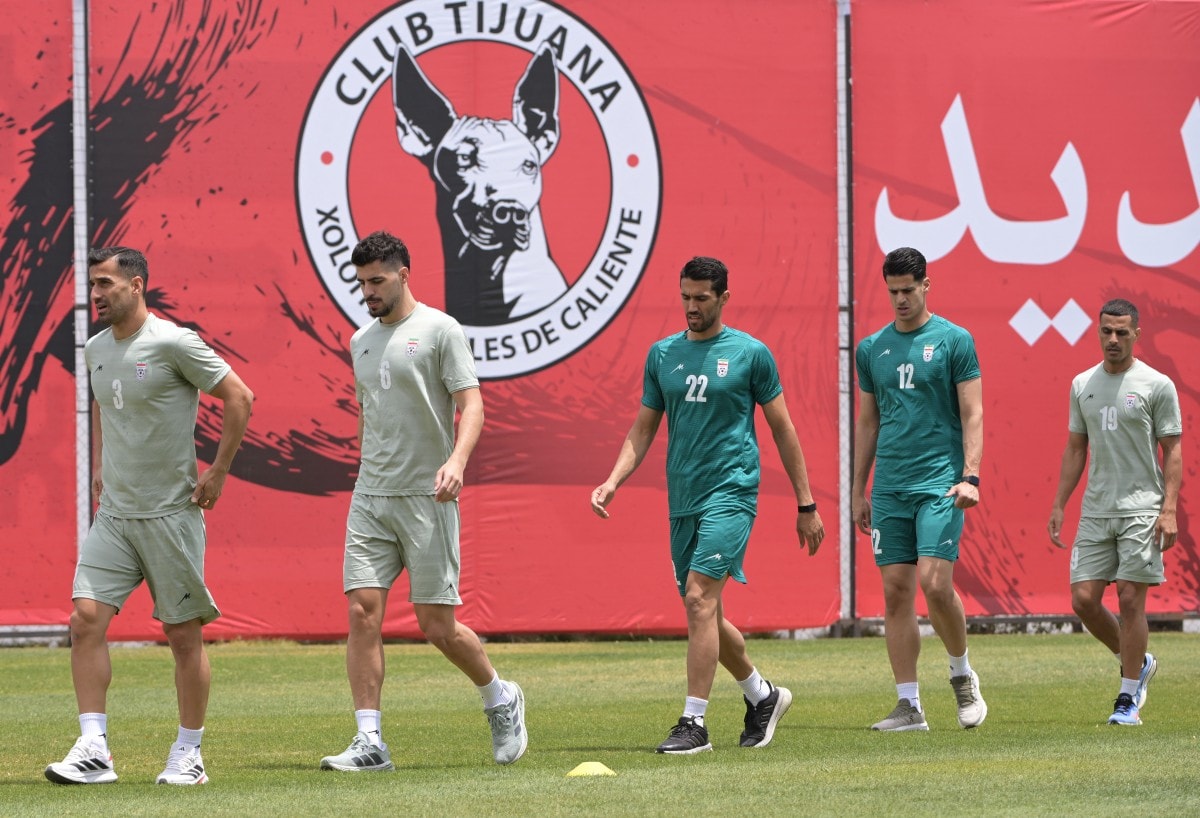
Iran's players take part in a training session during the 2026 World Cup football tournament at the Centro Xoloitzcuintle in Tijuana, Mexico.
Photo Credit: AFP
Questions intensified over the weekend when reports quoted Iran's ambassador to Mexico, Abolfazl Pasandideh, suggesting that Iranian players would be forced to enter and leave the US on the same day as their matches.
The reports immediately raised concerns about logistics, preparation and player wellbeing. International football teams normally arrive days before major fixtures. The prospect of a national side crossing an international border, playing a World Cup match and then departing within hours appeared extraordinary.
The US Department of Homeland Security moved quickly to reject the claims.
"These statements are untrue," a spokesperson said. "Thanks to the generosity of President Donald Trump the Iranian team will be able to arrive the day before their matches."
The clarification removed one source of uncertainty but not all of them.
Speaking through an interpreter from Tijuana, Ambassador Pasandideh criticised American authorities for denying visas to several members of the Iranian football federation. At the same time, he acknowledged that those who had received visas faced no restrictions requiring them to leave immediately after games.
"Their visas don't specify anything about them having to leave at a certain time," he said.
After weeks of uncertainty, US granted visas to all Iranian players only ten days before their opening match. Several members of the wider delegation were not as fortunate.
According to Iran's football federation and its embassy in Mexico, those denied visas include the team manager, two analysts, the media director and a representative from Iran's Foreign Ministry. Iranian officials have described them as key managerial and administrative personnel.
A US official said on Friday that the administration had issued "the visas necessary for Iran to compete in the World Cup."
The Ticket Dispute
If visas have become one point of contention, tickets have become another.
Just days before the start of the tournament, Iran's football federation announced that its allocation of tickets had been withdrawn.
The decision has left supporters who had already booked flights, accommodation and travel arrangements uncertain whether they will be able to attend matches.
Under FIFA regulations, each participating federation receives eight percent of tickets for its matches. Those tickets are normally distributed according to criteria established by the national association.
The Football Federation Islamic Republic of Iran (FFIRI) said it had already begun distributing tickets under the approved process when the allocation was suddenly removed.
"This is despite the fact that many Iranian football fans, relying on the officially announced process, had already made the necessary plans to attend the matches," the federation said.
The statement went further.
"Depriving Iranian supporters of access to their lawful and official allocation of tickets is an action contrary to the spirit governing international competitions and the principle of equality among participating countries."
The federation added that the development raised "serious questions" about whether political considerations were interfering with the organisation of the tournament.
Notably, the FFIRI did not identify who made the decision.
Instead, it appealed directly to FIFA to uphold neutrality, fairness and existing regulations.
For FIFA, which has spent decades insisting that football and politics remain separate, the dispute presents an uncomfortable challenge. The governing body issued a carefully worded response, saying it was working closely with Iranian officials to identify "compliant solutions" that maximise attendance opportunities for Iranian supporters.
Secretary General Mattias Grafstrom has already held discussions with FFIRI President Mehdi Taj following the team's arrival in Mexico.
According to FIFA, the conversation was positive.
"With the team now in Mexico, FIFA will continue dialogue and collaboration with the FFIRI to ensure the team and the delegation's experience is a positive one," Grafstrom said.
Those words reflect FIFA's traditional preference for diplomacy. Yet they also underscore how difficult neutrality becomes when a World Cup participant comes from a country directly involved in a conflict with one of the tournament's hosts.
Remembering Lyon
To understand why these developments resonate so strongly, it is necessary to return to France in 1998.
At the time, relations between Washington and Tehran were strained but showing tentative signs of improvement.
Earlier that year, Iranian President Mohammad Khatami had given a landmark interview to CNN. He proposed a "dialogue of civilisations" between Iran and US.
Khatami represented a different political tendency within the Islamic Republic. His election campaign had emphasised reform, tolerance and greater openness.
The timing mattered.
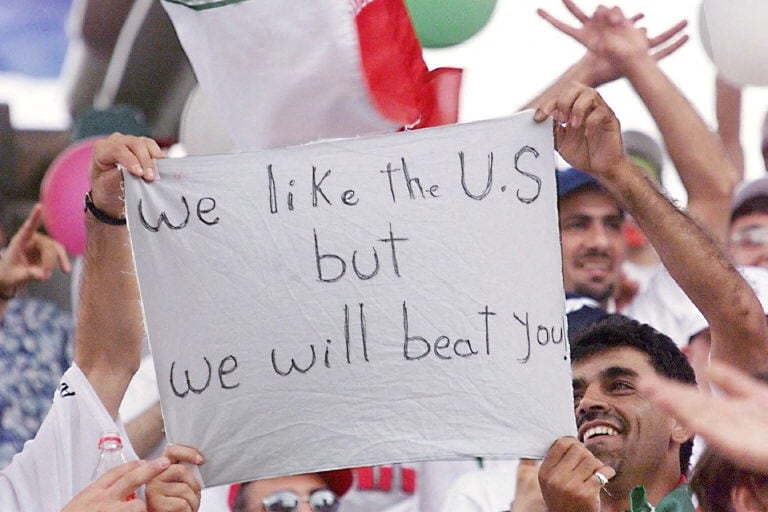
Iranian supporters display a placard 21 June at the Gerland stadium in Lyon, central France, before the FIFA World Cup Group F first round second match between Iran and the United States.
Photo Credit: AFP
Relations between the two countries had remained deeply troubled since the 1979 Islamic Revolution. The Clinton administration had imposed extensive sanctions and a comprehensive embargo on American commercial dealings with Iran in 1995.
Yet Khatami's language suggested an alternative path.
Drawing upon Alexis de Tocqueville's observations in Democracy in America, he highlighted what he viewed as shared aspirations for freedom and dignity.
The response in US was cautiously encouraging.
Travel regulations eased slightly. Discussions about improving relations gained momentum. Restrictions on imports of Iranian carpets and pistachios were relaxed.
But the opening encountered resistance from conservatives inside Iran, where anti-American rhetoric had become institutionalised over decades.
The thaw stalled before it could become something larger.
Then football intervened.
The World Cup draw placed Iran and US in the same group alongside Germany and Yugoslavia.
Suddenly, a football match became a diplomatic event.
The Road To France
Iran's journey to the tournament had already become part of football folklore.
Just weeks before the World Cup, the federation appointed Jalal Talebi as head coach.
Talebi was an intriguing figure for the role.
A former Iranian international, he had spent 17 years living in California's Bay Area. His wife operated businesses near Stanford University. Talebi himself had coached in local American football circles and even shared a professional connection with US coach Steve Sampson through De Anza Community College.
Iran's qualification campaign had been dramatic.
There were emphatic victories over Maldives and Kyrgyzstan. Midfielder Karim Bagheri scored goals at a remarkable rate, including seven in a single match against Maldives.
Yet qualification remained elusive.
Iran finished behind Saudi Arabia in the final Asian standings and lost a playoff against Japan when Masayuki Okano scored a golden goal in extra time.
One final opportunity remained: a two-legged playoff against Australia.
The first match in Tehran drew more than 1,28,000 spectators to Azadi Stadium. Australia escaped with a 1-1 draw, thanks largely to an away goal.
The return leg in Melbourne appeared lost for Iran.
Australia led 2-0.
Then everything changed.
Karim Bagheri scored. Moments later, Khodadad Azizi raced through to score the goal that transformed Iranian football history.
The 2-2 draw sent Iran to France on away goals.
Celebrations erupted across Tehran. Thousands of women entered Azadi Stadium despite longstanding restrictions. Even religious authorities chose not to intervene.
A nation had reached the World Cup.
Roses Instead Of Hostility
By the time Iran and US met in Lyon, political tension surrounded every aspect of the fixture.
A French television channel aired Not Without My Daughter, a controversial film depicting life under Iran's theocratic system. Iranian officials accused broadcasters of deliberately inflaming tensions.
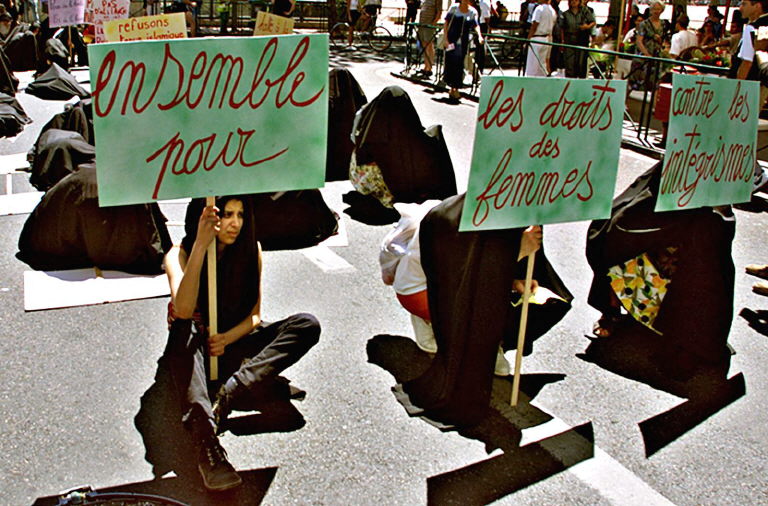
About 50 people, mostly women and among them Iranian exiled, stage a sit-in as they demonstrate in solidarity with Iranian and American women against fundamentalisms, June 20 in the streets, central France, on the eve of 1998 Soccer World Cup group F match between Iran and the United States. Placards read (from L): 'Together for women's rights against fundamentalisms."
Photo Credit: AFP
"It is not the right thing to show this untrue thing about Iranian culture," said Talebi. "In the World Cup, everyone speaks of unity and love and togetherness, and somebody shows this film. Nobody can benefit, except to make everybody unhappy in our camp."
Azizi, the reigning Asian Player of the Year, was determined to beat the Americans at all cost even before the film was aired.
"We will not lose the game," he said during a pre-World Cup tournament in Tehran. "Many families of martyrs are expecting us to win. We will win for their sake."
Khodadad Azizi declared before the tournament that Iran would not lose.
American coaches were denied opportunities to scout the Iranian team after disputes surrounding previous sporting exchanges.
Reports emerged that the Mojahhedin-e Khalq, an Iraq-and-Saddam-Hussein-backed militant group, had acquired thousands of tickets in hopes of staging anti-government protests.
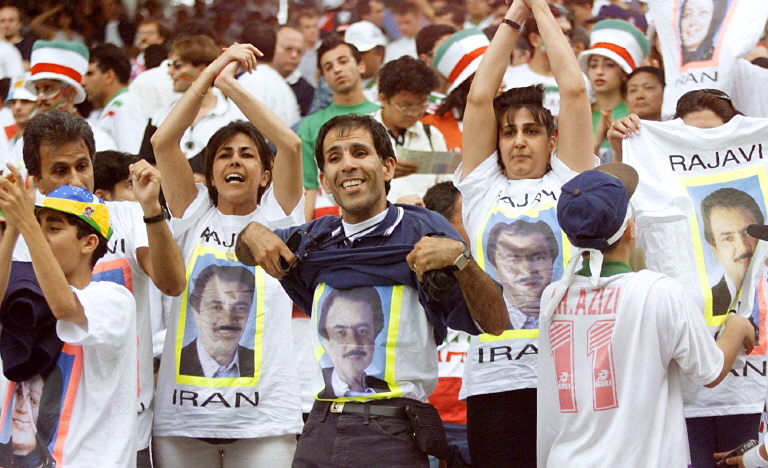
Iranian supporters of the Iranian National Resistance Council (CNRI) displaying portraits of Mujahedeen leader, CNRI president Massoud Radjavi, cheer 21 June at the Gerland stadium in Lyon, central France, before the FIFA World Cup Group F first round second match between Iran and the United States.
Photo Credit: AFP
Then came an unexpected complication.
Under FIFA protocol, Team B approaches Team A for the pre-match handshake.
Iran was designated Team B.
Iran's Supreme Leader, Ayatollah Ali Khamenei, had reportedly instructed that no Iranian should walk towards American players.
FIFA suddenly found itself conducting diplomacy rather than organising football.
The Americans approached the Iranians. Then came the flowers. Each Iranian player carried white roses. The image travelled around the world.
Iran won the match 2-1.
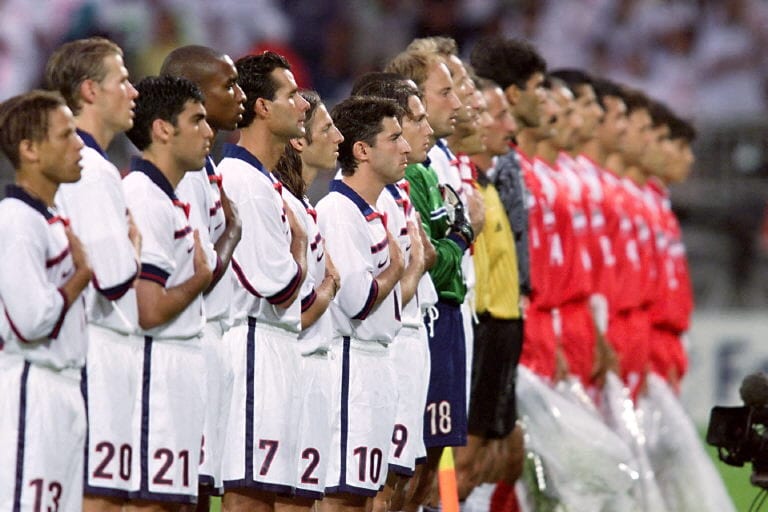
USA and Iran's teams listen national anthems 21 June at the Gerland stadium in Lyon, central France, before the FIFA World Cup Group F match between Iran and the United States.
Photo Credit: AFP
Hamid Estili scored before half-time. Mehdi Mahdavikia added a second late in the game. Brian McBride replied for the US, but Iran held on. Neither team advanced from the group. Yet for many Iranians, victory over the United States felt historic. Not because of the result alone.
Because of what surrounded it.
And the contrast with 2026 could scarcely be sharper. The optimism that accompanied Khatami's call for dialogue has long since faded. Years of sanctions, nuclear disputes, proxy conflicts and regional competition have transformed relations once again.
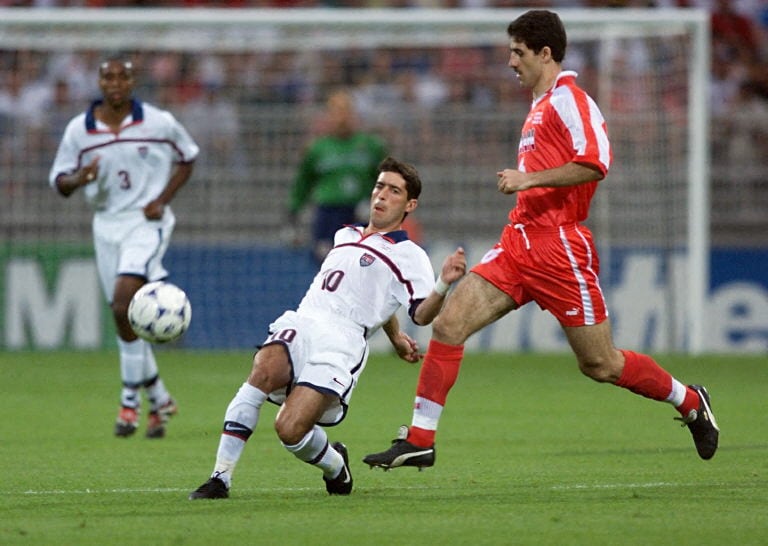
US midfielder Tab Ramos (C) is challenged by Iranian midfielder Karim Bagheri, as teammate Eddie Pope (L) looks on, 21 June at the Gerland stadium in Lyon, central France, during the FIFA World Cup Group F match between Iran and the United States.
Photo Credit: AFP
Team Melli
The irony is that Iran arrives at this tournament with considerable footballing ambition. For decades, Iranian football has steadily increased its international profile.
The team that reached France in 1998 was largely domestically based. Today, Iranian players have established careers across European leagues. Exposure to higher levels of competition has strengthened the national side. The transformation became evident during the 2018 World Cup cycle under Carlos Queiroz. Iran reached Russia unbeaten in qualification and emerged as Asia's highest-ranked team.
Iran's 2026 World Cup schedule begins against New Zealand in Los Angeles on June 15, followed by Belgium in the same city on June 21. The group stage concludes against Egypt in Seattle on June 26.
On paper, progression remains possible.
Whether football discussions can remain separate from politics is another question.